namaste Nepal

Come and join us! Bring your backpack with you and let us show you around Nepal. We promise that you will start your journey in Nepal as a customer of us but last as a friend. This is what we have been doing all along.

Explore Nepal Himalayas! Touch Your Big Sky!

Tuesday, 21 February 2017

2 Days Poonhill trek from Pokhara

If you have very short day in Pokhara and if you are physically fit why you stay in city area let's Trek to Poonhill and finish it on 2 days


2 Days poonhill trekking is really hard for normal people if you are physically fit you can do this trek in 2 days

  • Day 01: Pokhara to Ghorepani  (2850m)
  • Drive 42km Approximately 1:5 Hours and walk 19km to Ghorepani, 8 hours walk 
Early in the morning we drive to Nayapul on the way we pass some beautiful village and scenery, we will stop for while to take picture close to Nagdada and cross the beautiful village Lumle and reach in  Nayapul  (1100m) and Hire a jeep till Hile and had Lunch there and climb to Ulleri and some tea break after that  passes beautiful forest and waterfall and arrive in Ghorepani and take a rest and after dinner sleep
  • Day 02: Ghorepani to Poon Hill ( 3210m  )  and Trek to Hile / Jeep to Nayapool and drive back to Pokhara 
  • Trekking distance 19 kms – Approximately 7  Hours walk 
Wake up early morning prepare for the sunrise , suggest wear warm clothes and take headlight  start to Hike up to Poon Hill  (3210m) 45 minute climb. from Poon Hill we can see beautiful sunrise and beautiful mountain from poon hill we can see Mt. Dhaulagiri (8167m.), Tukuche Peak (6920m.), Nilgiri (6940m.), Varaha Shikhar (7847m.), Mt. Annapurna I (8091m.), Annapurna South (7219m.), Annapurna III (7855m.), Machhapuchhre (6993m.), Annapurna IV (7525m.), Annapurna II (7937m.), Lamjung Himal (6931m.) and other numerous snowcapped mountains Descend back to Ghorepani and after having breakfast After that, return same way to Hile all the way down and take a jeep from hile to Nayapool and drive back to Pokhara
Ghorepani Poonhill Trek 
Panoramic View from Ghorepani Poonhill 

Trekking Grade

Trekking Grades in Nepal Himalayas 
Trekking Grade in  Nepal 
Trekking in Nepal can be graded as different levels according to route features and elevation varies place to place. Some trekking routes are combined with higher level of elevation which requires some different standard of physical fitness and acclimatisation or rest day. Trekking in Nepal can be done by all levels of trekkers; if they think themselves fit and have strong desire. People suffering from cardiac or respiratory problems should consult to their personal doctor. Eco Trek Nepal like to advice morning and evening walks, jogging; stretching, meditation and regular exercise helps comfortable for all. It is essential to choose a trek that is fit to your capabilities and present health condition.

Easy or Grade A
Grade A trekking can be ideal for any age group and this type of trekking involves bellow 3000m of elevation and duration will be about not more than 10 days. It is the easiest treks, tours and walking in a day is not exceeding more than 5 hours, but it is depend upon to your walking speed. These types of trek also allow plenty of opportunities to view the Himalayas and encounter local culture.

Moderate or Grade B
Moderate or Grade B level of trekking holiday involves about two weeks long covering elevation above 3000m to 5000m below. Generally this type of trek also requires well fitness of physical conditions and about 6-7 hours of hiking capabilities. This type of trek also involves mixture of some longer and shorter hike and trails can be rough, steep and have many ‘ups’ and ‘downs’ with some exposure.

Strenuous or Grade C
Grade C types of trek involve a 5000m or few meters up level of trails with side trips to higher elevations. Considered to be harder therefore preparation for fitness and good health conditions are essential. However, you must be very fit for this sort of trip. Those who suffer from asthma, high blood pressure, heart disease or complicated medical conditions related hikers are not recommended.

Very Strenuous or Grade D
Very Strenuous trekking grades is best described as Alpine and most strenuous, which require mountaineering skills and knowledge.  The elevations range from 4000m to 6000m and approximately 7 hours walking a day for the trekking in Nepal. It covers very remote areas, travelling over snow-covered passes at an altitude of up to 6000 meters. You may need to axes and crampons to cross the pass when there is heavy snow

Challenging or Grade E
Challenging Trekking grade is limited to those with an excellent level of personal experience and fitness of an outstanding sense of humour and high tolerance levels. It is challenging trekking, which the most are fascinating and operating to the height of 6000m.  It is the most exciting to observe them. This type of trek needs 16- 28 days more for going the trekking on the higher altitudes. During the trek you may have to cross-snow – covered passes in very remote areas or climb up to 6000 meters in altitude.

Nevertheless we want to warn our trekkers that the level of difficulty of a trek is very subjective. Weather conditions, your physical condition, possible health problems during the trek and other factors can have an important influence on the way you experience a trek.

TIMS information

Trekking Information  Management  System  ( TIMS ) 
Tims Card in Nepal 

TIMS card is for Trekkers  safety.
With the distinction of Nepal as a trekking destination and its growing charm, a provision of the Trekkers' Information Management System (TIMS) has been implemented to ensure safety and security of the trekkers and to control illegal trekking operations.

As a trekker entering a protected area in Nepal, you will be asked to provide some information about the dates of your trip, the itinerary, and a contact number. These data will be inserted in the visitors’ database, where they can be accessed for park management purposes or in case of accidents and/or natural calamities, in order to inform the concerned institutions about the trekkers inside the park at anytime.

TIMS cards should be collected by both Free Individual Trekkers (FITs) and trekkers taking the service of government authorized trekking agencies.

Past experiences have revealed that difficulties were seen while carrying out rescue operations during times of accidents and natural calamities. Due to the lack of proper record system of trekkers, rescue and search missions used to face difficulties in spotting the missing trekkers. Based on the data collected through TIMS cards, however, it will be possible to know the position of a trekker in case a rescue operation is needed.

The provision of Trekkers' Information Management System (TIMS) came into effect on January 1, 2008. Since then, the Trekking Agencies Association of Nepal (TAAN) and Nepal Tourism Board (NTB) started recording trekkers’ details and began issuing TIMS Card to trekkers.

NTB and TAAN signed a Memorandum of Understanding (MoU) on March 18, 2010 to implement the TIMS system in a new format from April 1, 2010. NTB and TAAN have introduced separate TIMS Cards for FITs and organized groups. FITs need to have Green TIMS cards by paying Nepali currency equivalent to US $20 per person, while those travelling in groups need to have Blue TIMS cards by paying Nepali currency equivalent to US $10 per person. Trekkers taking the service of trekking agencies can pay fee for TIMS card in US dollars.


Where and how to obtain a TIMS Card?
Free Individual Trekkers:
TIMS Information in Nepal 
Free Individual Trekkers can obtain TIMS cards at the offices of Nepal Tourism Board in Kathmandu and Pokhara, TAAN Secretariat at Maligaon and TAAN Pokhara Secretariat in Pokhara upon filling the TIMS application firm.

Organized Trekkers:
Trekking companies will collect trekkers’ data and enter it in the central database and will provide trekkers with a TIMS card after paying fee prescribed above.

Opening Hour/s:
-          TIMS counter at TAAN follows regular working hours (10am-5pm) and 365 days a year
-          NTB Offices follow government working hours and days.
-          Trekking agencies open 12 hours a day seven days a week.

Documents Required:
-       To obtain TIMS Card you need copy of:
a) Passport
b) two (2) Passport-size Photographs.


Why is TIMS Necessary?
The following considerations have been taken into account in the process of issuing TIMS:
All important details regarding trekkers and trekking routes shall be maintained in a computerized Database Management System, which can be useful for the trekkers’ safety and security. In order to help carry out search and rescue operations for trekkers in case of natural calamities and other accidents by means of Authentic Information Service. To maintain a record system that includes personal details of trekkers, trekking area, trekking routes, handling agencies, duration, etc. The data generated from the system will be useful to all concerned stakeholders such as tourism organizations, Government agencies, diplomatic missions, tour operators, research institute, etc.

Unauthorised trekking operations will be controlled, thus, resulting in better management of trekking services, which will not only benefit trekkers and field staff, but also trekking companies and Government agencies. Occasional untoward incidents will also be better prevented. Plus, TIMS will upgrade the service standard and will contribute to better management of sustainable mountain tourism development in Nepal.


TIMS will not be required for:
- Expedition members permitted to climb the mountains
- Visitors in the controlled areas with permits by the Department of Immigration
- Foreign guests invited by the Government of Nepal
- Authorities from the various diplomatic missions present in the country, who hold official letter/s and travel at their own risk
- Visitors on certain missions recommended by the concerned Governmental Department(s);
- Foreign Nationals possessing a residential visa.

Revenue collected from distribution of TIMS cards is shared into three equal parts for following purposes:

1. Nepal Tourism Board (NTB) will use the first part for printing TIMS cards, holograms, managing issuing counters and use the remaining  amount for tourism marketing, publicity and promotion.
2. The second part is utilized in the welfare of trekking workers like buying medical and accident insurance policy for them and conducting rescue operations in case of accidents. The amount is also used to launch various programs as a part of corporate social responsibility (CSR) and meet administrative expenses.
3. The third part is utilised to develop infrastructures, promote, conserve, maintain trekking trails. A substantial amount is also utilized to explore, develop and promote new destinations besides organising training and workshops for sustainable and responsible tourism development.

Trekking Season in Nepal

Trekking season in Nepal Himalayas 
Nepal Trekking Season generally known best as two seasons after falls and after the winter.  The following month mid of September to mid of December consider ever best season of trekking in Himalayas. During this period of months have pleasant climate condition not so hot and cold and visibility of mountain are crystal clear. There is another best season of trekking Nepal after winter when sun getting more warmer in spring time may trekkers to Himalayas can again enjoy comfortable climate condition. In spring season in Nepal many different types of flowers bloom both trees and ground and it is also the best time to climb up peaks for expedition.

Autumn (September-November)
Autumn is considered as the best trekking season for the trekking in Nepal. September, October and November are fall in this trekking season in Nepal. During in this season offers excellent weather and beautiful  mountain views. Temperature is moderate, making it a good time for any trekking. The sky is generally clear with outstanding views. Occasionally short storms may dump considerable snow at high altitudes.

Winter (December - February)  
​This season is noted for occasional snowfall at higher elevations in Himalayas. Though it gets colder in night, often it offers the clear day / blue sky and relatively less trekkers on the trail. However, we need to be selective in choosing the winter trekking as climbing and crossing high passes trip won’t be an ideal option. Trek like Everest base camp, Annapurna Panorama, Jomsom Muktinath, Panchase Hill ,  Annapurna Sanctuary, Instant Everest treks etc can be done even in winter.

Spring (March - May) 
Different varieties of wild flowers, specially the rhododendrons, make the hillside above 5000 meters a haunting paradise during this season. It is mildly warm at lower elevations and at higher elevation over 4000 meters the mountain views are excellent and temperature is quite moderate.
​
Summer (June - August)  
Summer months really continue up to mid-September making travel wet and warm. These times are blessed for the keen botanist as the higher valleys and meadows blossom with flowers and lush vegetation. Insect repellent is a nice addition to your What to Bring list. During this season, you can trek in the rain-shadow (places are out of reach of the rain clouds because of the high mountains) areas north of the Himalaya like Mustang and Dolpo.

Trekking Tips

Trekking Tips

Legal Documents

Our Team

OUR TEAM 


Big Sky Treks & Expeditions Pvt Ltd is well known government Trekking And travel Company in Nepal which  it is located in beautiful city in Pokhara . After do long trekking in Nepal Himalaya and collect a lot of experiences from different Trekking Route with Different  Nationalities Trekkers decided open own company where is well trained Guide and strong Porter work in Big sky Treks 

Owner / Trekking Guide / Founder 
Bhakti Devkota 


Trekking Guide
Arjun Chapagai


Trekking Guide
Bharat Devkota


Trekking Guide
Amrit chapagai


Trekking Supporter
Chubanath Chapagai


Trekking Supporter
Devilal Poudel  ( Aka MaMa )


Trekking Supporter
Raju Devkota

Trekking Supporter
Sagar Devkota


Why Choose Us

About Company

Nepal is located in the Himalayas and it is famous for its snow-capped mountain peaks. There are 14 peaks over 8000 meters worldwide and eight of them are in Nepal, including Mount Everest, the highest point on Earth. More surprisingly, there are more than 1300 peaks over 6000 meters in Nepal. With these magnificent peaks, Nepal can be considered as the glorious kingdom of high mountains. Every year, Nepal attracts thousands of travellers and explorers around the world to see its picturesque beauty.
Nepal is not only a country with many unforgettable natural views, but it is also a multicultural country with many historical buildings. The above-mentioned characteristics and attractions of Nepal make it become one of the must-see travel destinations to many people. Are you planning your trip to Nepal at this moment? Have you ever thought about getting away from the crowds, simply sitting in front of a mountain house with breathtaking views of the Himalayas and slowly sipping a cup of nice coffee? If you have been looking for a trustworthy trekking company for a while and you haven’t found any yet, you can stop searching for another trekking company from now on, because Big Sky Treks, a government registered trekking company and a member of Trekking Agencies’ Association of Nepal (TAAN) is the best choice for you.
The founder Bhakti Devkota of Big Sky Treks is a professional trekking guide with over 20 years of experience. Through the years, Devkota has been a trekking guide with well-reputation and a huge amount of people who have participated his trekking tours keep coming back for more explorations with him. Big Sky Treks has the best team members with good quality services and itineraries, including various hiking and trekking trails, outdoor and adventure itineraries, cultural and theme tours, home stay experience and so on. We also provide customised itineraries with detailed information which can meet your needs. More importantly, we believe that the sustainability of Big Sky Treks depends on creating lifelong travel memories for each and every travellers in Nepal.
Come and join us! Bring your backpack with you and let us show you around Nepal. We promise that you will start your journey in Nepal as a customer of us but last as a friend. This is what we have been doing all along.
Explore Nepal Himalayas! Touch Your Big Sky!

Wednesday, 15 February 2017

Bungy jump in Pokhara

Pokhara Bungee Jumping is the highest water touch Bungee in the world. Situated at Hemja near the Tibetan Camp in Pokhara, This bungee jumping is made from a tower which is  at the height of 80 meters from where you dive to the pond 18/20 meter deep.Bungee jumping trip in Pokhara.You can get full enjoyment  there doing Bungy jumping, making videos, taking pictures and viewing nature around you.

Short Hiking around Pokhara

Hiking & Trekking
Short Hiking around Pokhara 
Pokhara, besides being one of the major city of the Himalayan kingdom, NEPAL, is the place from 
where one can start the most exciting treks to the Annapurna region, which is seen hanging out in front of you as you enter the Pokhara. These mountains are just 30 – 40 km away from Pokhara.

Hiking and Trekking

Trekking in Pokhara is very new and started only three decades ago. Annapurna was the first mountain in Nepal to be climbed in 1950, before Everest, which afterwards attracted the people from all over the world. After the successful climb of the Annapurna the attention of the world came to Pokhara as its scenic beauty couldn’t be overlooked. Pokhara was soon the destination of all tourists who visited Nepal and within three decades it has become the major tourist attraction after Kathmandu.

One of the major attraction that fetch tourists is trekking. Since Pokhara is the best place to set out to the rural villages that are lying in the mountains, many tourist visit Pokhara each year for this purpose.

From Pokhara you can enjoy one day trips, short trips and long trips. Under one day trips, you can travel to the place around the valley and enjoy the natural beauty with very friendly people. Short trip means the trek lasting for about a week and the treks that take more than a week are categorized as long trips.

Sarangkot
This small village, perked on top of a hill just 5 kilometers from Pokhara’s Lakeside seems to be making something of a comeback, after falling from tourist favor about fifteen years ago. In those days the start of trekking in the Annapurna region usually started at Bindabasini Mandir, north of Pokhara, and took the trekker through Sarangkot and along the ridge to Nayapul. The completion of the Pokhara-Baglung road changed all that! This year the only good news in a dismal tourist season has been the explosion in numbers of people trying their hand at paragliding and the place from where to launch oneself into the air is Sarangkot. Lodges and restaurants are reporting a better business. But you might also want to come here for wonderful mountain views, quite enjoyable walking along the ridge top or simply to escape the heat of Pokhara. At 1592 meters above sea level, Sarangkot is a good five degrees cooler than Pokhara.

Pokhara – Sarangkot – Pokhara
The Sarangkot hill is very popular for its best Mountains and sunrise view. We start our trip early morning around 5-5:30 am by car .Normally sun rises at 6 am. After the sunrise and Mountain View we walk down from sarangkot along with the pokhara city view and the Fewa lake view with green forest. We walk around 4-5 hours.
Note:-The length of the time depends on your choice of route.


Dhampus
Pokhara – Sarangkot – Naudanda – Dhampus – Pokhara (2 days)


This route is popular both for mountain and sunrise view and to experience the Nepalese village life. The view point, Sarangkot offers the excellent panoramic view of Annapurnas and the sunrise while Naudanda offers the dramatic view of the twin tails of Machapuchhre (Fishtail) and the massif Dhaulagiri view. We walk through the Kaskikot village ,Naudanda village and the culturally rich Dhampus village where the view of Annapurnas seems very close and we can feel the cool and fresh air of the mountains.

Pokhara – Dhampus – Naudanda-Pokhara (1 day)
The main focus of the hike in this area is the scenic beauty of Naudanda and the ancient traditional culture and the great panoramic view of mountains from Dhampus village. While walking we pass through the diverse forest with the rhododendron and wild orchid flowers. We walk through the terraced rice fields and through the stone houses with thatched roofs.

Pokhara-Lahachowk – Ghahachowk-Pokhara (2 days)
This route offers the scenic beauty and the oldest settlement rich in culture; we start our walk from the Hemja village, famous for orange garden. We cross Seti and Mardi River to reach this typical Gurung village.

Pokhara – Chapakot – Pokhara (1 day)
After the 45 minute drive from Pokhara, we start walking from Pame west of Pokhara. We follow the Harpan River, the source of Phewa Lake then climb the hills with small villages. We walk through paddy field with the mountain and lake view.

Pokhara – Ramche Danda- Pokhara (1-2 days)
After 45 minutes drive south of Pokhara, we start our 7 hours hike climbing the hills, passing through villages and cultivated land. We walk through the forest of religious Chandan and oak tree. The smell of mountain can be sensed when we walk through the extensive forest of Rhododendron.

Pokhara – Foksing – Pokhara (1-2 days)
Around 10 minutes of drive south of pokhara we climb the hill passing the suspension bridge. The Foksing hill is popular for its fascinating mountain view. The Orange garden and the terraced rice fields and the typical Nepali houses with thatched roof can be experienced. The length of stay could be prolonged if you are interested to stay overnight with the villagers.

Pokhara – Kalikasthan – Pokhara (1-2 days)
This is the best view point to view the serene 7 lakes around Pokhara. The panoramic view of Annapurnas and the experience of village life is the highlight of the hiking.

Pokhara – World Peace Pagoda – Pokhara (1 day)
World Peace Pagoda, a massive Buddhist stupa is situated on the top of a hill on the southern shore of Phewa Lake. Besides being a impressive sight in itself, the shrine is a great vantage point which offers the spectacular views of the Annapurna range, Phewa Lake, and the Pokhara city. We Climb the Raniban forest crossing the suspension bridge. After the 2 hours of walk we reach stupa and enjoy the spiritual and scenic beauty. Climbing down from Pagoda is more enjoyable with the view of Phewa Lake and the mountains. We cross the lake after the 20 minutes of boating with the visit to island temple (Barahi temple) in the middle of lake.

Kahun Dada
It is another enchanting hill north of Pokhara and takes about two and a half hours to reach from Mahendrapul. The trails starts from near the army barrack at Phulbari across Mahendrapul and climbs slowly up a slope. The essential view from top of this hill is the panoramic view of the Annapurna range and the flat span of Pokhara valley.

Pokhara – Kahun Danda – Pokhara (1-2 days)
Normally, this is one day hiking route but if you are interested to spend some time with the villagers you can make it for 2 days. The Khaun Danda (1520 m) to the northeast of Pokhara has a ruined fort on the summit as well as a view tower with spectacular scenery. The dramatic change of colours after the sunrise on the Annapurna gives you the experience of natural beauty.

Short Hiking around Pokhara 

Things to do in Pokhara

Know about Pokhara 
Beautiful Pokhara 
Pokhara is a remarkable place of natural beauty. Situated at an altitude of 827m from the sea level and 200 km west of Kathmandu valley, the city is known as a centre of adventure. This enchanting city has several beautiful lakes and offers stunning panoramic views of Himalayan peaks. The serenity of lakes and the magnificence of the Himalayas rising behind them create an ambience of peace and magic.
Pokhara is part of a once vibrant trade route extending between India and Tibet. To this day, mule trains can be seen camped on the outskirts of the town, bringing goods to trade from remote regions of the Himalaya. This is the land of Gurungs and Magars, hardworking farmers and valorous warriors who have earned worldwide fame as Gurkha soldiers. The Thakalis, another important ethnic group here, are known for their entrepreneurship.

The activities of foreign visitors to Pokhara focus around two districts known as Dam side and Lakeside (or Pardi and Baidam, in Nepali, respectively). These two areas, with their strips of hotels and restaurants, are a few kilometers south-west of the main Pokhara bazaar.

Pokhara is located in the mid western Nepal and a six-hour drive or 20-minutes flight from Kathmandu. Pokhara, the centre of adventure in Nepal, is an enchanting city nestled in a tranquil valley. Due to its stunningly beautiful natural setting and the suitable base for trekking in the Annapurna region, Pokhara is one of the most popular tourist hubs in Nepal after Kathmandu. It is the starting point for many of Nepal’s most popular trekking and rafting destinations. The majority of the people of Pokhara are Brahmins and Chettris from Kathmandu and Tibetan settlers. The best time to visit Pokhara from September to December and March to Jun, but can visit any time of any seasons.

Climate: 
The climate of Pokhara is slightly warmer than Kathmandu with daytime temperature hovering around 17 degrees Celsius in winter and 32 degrees in summer. The monsoon season which lasts from mid-June to mid-September is very wet; in fact Pokhara records the highest rainfall in the country. Best time to visit is between October and April.


Adventure in Pokhara

Mountain Biking in Pokhara
Golf course in Pokhara
Rafting near Pokhara
Pony Riding


 Lakeside Pokhara

a) Fishing in Pokhara
b) Boating in Pokhara
c) Relax in Pokhara

Landmarks in Pokhara
a) Devi’s fall
b) World Peace Pagoda
c) The Old Bazaar
d) Caves in Pokhara
e) Museums in Pokhara
f) Rupa and Begnas Lake
g) Barahi Temple
h) Bindibashini Temple


 Beautiful Mountains and Sunrise

Fishtail from Pokhara 
Phewa lake 
Davi's Fall 

Tuesday, 14 February 2017

Nepali New year

Nepali Flag 
The New Year is celebrated by the Nepali people and is also known as Navavarsha which is based on Nepal’s lunar calendar called Nepal Sambat. The first day of the Nepal Sambat usually falls around the 11th to the 15th of April. The Navavarsha is one the many festivities of Nepal celebrated with parades, parties, family gatherings and a lot of food.
History of the Nepali New Year
The Nepali custom celebrates their religious merriments on a varying date because it is based on the lunar calendar as opposed to their national holidays that are observed on fixed dates.
The Nepali New Year or the Navavarsha according to the locals is a religious holiday celebrated with great significance and is observed with deep respect and devotion. Just like many other countries, they commemorate the event with the hopes of having a lot of blessings and prosperity as they face the New Year.

Nepali New Year Traditions, Customs and Activities
The celebration of the Nepali New Year comes with joyful activities that include street dances, parades and reunions. The occasion has always been enthusiastically participated and fully funded by the organizations and individuals.
The Navavarsha usually falls during the 2nd week of April which is considered by the Nepalese as the first day of Baisakh, the first month of the Bikram Sambat calendar. It’s a time of the year where the entire country rejoices with colourful ornaments and social activities as they welcome the New Year.
The major part of the event is centred to their religion. According to their rituals, the locals spend their time early in the morning with prayers and worships inside their temples and offer Puja which is a ritual devoted for their gods. After they present the Puja, they would walk around the temple opposing the direction of the clock as they ring bells.
Parts of the event are the traditional games and sports that the people organise during this day. Most of the youth participate in pageants and contests to showcase their talents as well.


Teej Festival in Nepal

Teej is the fasting festival of women in Nepal. It falls in the month of August or early September. Married women observe Teej fast to honor Lord Shiva and for long and healthy life of their husband. Unmarried girls also observe fast on this day for a good husband. Teej celebrations lasts for three pious days. Traditional dances and songs form an important feature of Teej celebrations. Red color is considered auspicious for women observing Teej fast and so most of them dress up in red or bridal clothes.

Teej Celebrations
Teej is an annual festival of Nepali women. The festival is celebrated with utmost dedication and love by the women in Nepal. Preparations for the festival begin well in advance. Fabric stores, sarees and suit outlets are stocked with the bridal red color fabric. Women spend most of the time shopping when Teej is near.

Teej festival celebrations are carried further with sumptuous feasts and traditional performances. On this day, women dress up beautifully. They clad themselves in red colored apparels, wear glass bangles, heavy ornaments and apply henna. Teej gives women an opportunity to dress like the newly wed. They worship the epitome of divine marriage - Lord Shiva and Goddess Parvati, for longevity and prosperity for their husband and family.

Three Days of Teej
Teej is a three-day-long festival in Nepal and each day has its own significance.

First day is called 'Dar Khane Din', the day to make merry.
Second day is a 'fasting day'.
The third day is called 'Rishi Panchami' in Nepal which is a day to perform Teej Puja.

Dar Khane Din
The first day of Teej in Nepal is called the 'Dar Khane Din'. On this day, the womenfolk dressed in the finest clothed gather at one place and perform traditional dance and sing devotional songs. A special food called 'dar' is eaten. Celebrations continue till midnight after which the 24-hour-long fast begins.

Fasting Day
The second or the fasting day of the Teej festival is dedicated to pujas and prayers. The holy Pashupatinath temple is thronged by women in red sarees to offer prayers to Lord Shiva. Women gather in the temple and circumambulate the Lingam (phallic symbol of the Lord) adorned with flowers, sweets and coins. The beautifully decorated idols of Shiva and Parvati are offered fruits and flowers to seek blessings of the divine spirits. Lighting of an oil lamp is very important part of the puja ceremony. It is said that the oil lamp should be kept lit all night to avoid bad omen.

Rishi Panchami
The third day of the Teej Festival is called Rishi Panchami. On this day, the seven sages of the Hindu pantheon are worshiped by women in a belief that it will cleanse all sins of the previous year. Womenfolk take a holy bath with red mud found on the roots of the sacred Datiwan bush, along with its leaves. After three hours of rigorous cleansing, they come out purified and absolved from all sins. After this they sit in a semicircle while a priest sitting in the middle chants devotional prayers.

Maha Shivaratri Festival in Nepal

With sadhu 

Maha Shivaratri meaning the night of Lord Shiva is one of the major festivals of Nepal and literally means “Night of Shiva”. It is celebrated on the 14th day of the dark fortnight of the Māgha month, as per the Hindu lunar calendar. 
It is believed that on this day, the stars in the Northern Hemisphere are at most optimum positions to help raise a person’s spiritual energy. It is also believed that the Shiva principle is most active on this day of the year. 
Maha Shivaratri is celebrated marking the convergence of Shiva and Shakti. Maha Shivaratri also celebrates the night when Lord Shiva performed the "Tandav", the cosmic dance. 
Hundreds of thousands of devotees visit Pashupatinath Temple in Kathmandu, one of the holiest shrines of the Hindus.  
Pashupatinath is considered the Guardian and Protector of the Kathmandu Valley and Nepal.  Devotees chant “Om Namah Shivay” and “Mahamritunjaya” all night praying for light over darkness. Tourists are seen enjoying the ambiance with curiosity, as colorful and naked sadhus are seen meditating, posing for photographs and interacting with disciples.  
Special attendance camps are set in the courtyards of the temples. Children are seen collecting donations from passersby on this day preparing for holy meal and bonfire in celebration of the special night

Pashupatinath Temple 

Pashupatinath Temple 
Tallest shiva statute in world 


Monday, 13 February 2017

Holi Festivals Tour in Nepal

Celebrating holi with guest During the trekking in Nepal 
Holi is considered as one of the major festival of Nepal which falls on the full moon day of late February or early march. Also known as Fagu Purnima, the festival of Holi got its name from a mythical demoness Holika. It is the festival of colors that lasts a week but only last two days are celebrated with colours.

A long bamboo pole with strips of clothes tied at its top is installed on the first day, in the Hanuman Dhoka Durbar Square in Kathmandu. The pole is known as Chir. It symbolises the tree on which Lord Krishna hung the milk maids’ clothes while they were bathing in the Jamuna River in northern India.
On the last day of the week, the pole is taken to a bonfire. According to the legends, Holika and her brother King Hiranyakashyap planned to kill his son. The King was proud of him and considered himself God. His son Pralad was a great devotee of Lord Vishnu and he never acknowledged his father as God unlike all the citizens of the country. Afraid that others might follow the suit and angry at his son, he and Holika conspired to kill Pralad.  Holika had received blessing from Lord Bramha that fire could not burn her. So she took Pralad in her lap and sat on top of the hay stack. But the blessing only worked for good purpose, so, she burnt alive. Pralad was saved by Lord Bishnu. Thus, Holi is celebrated to remember the victory of devotion over evil.

People in Terai region and the Marwari communities of Kathmandu celebrate it a day later than the Hilly regions. Holi is considered as the festival of forgiveness because people forget their anger and enjoy coloring each other. They put color, splash each other with water and hit each other with water balloons. Also hitting strangers with balloons and water is practices. Maalpuah, a special type of soft roti is the main food of the occasion. People also indulge themselves in Bhaang and alcohol during Holi.
For the Date and time please mail us we will inform according to our moon calendar

Celebrating holi with guest During the trekking in Nepal 

Celebrating holi with guest During the trekking in Nepal 

Diwali Festival Tour in Nepal

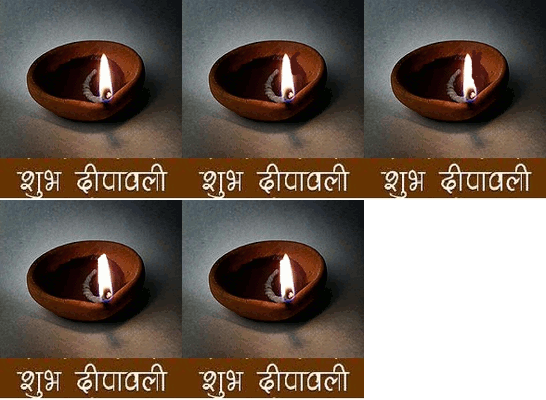
Tihar is one of the most dazzling festivals of  Nepal. Tihar is also known as Deepawali Diwali and Yamapanchak. Tihar festival falls during the month of October-November. This festival is celebrated for five days, beginning from the 13th day of the waning moon in October-November.

In this festival, people worship Goddess Laxmi, known as the Goddess of wealth. All the houses of the city and villages are cleaned and decorated with lit oil lamps. During the night time, the cities and villages look like shining diamonds. Many people call Tihar as "Yama Panchak" which means the five days of the lord of the underworld. These five days are considered as very important which reflect respect not only for the human and god but also animals and birds like crows, dogs and cows who share a strong relationship with local people. During this festival many people decorate the exteriors of their houses by making Rangoli of different colors and flower petals of saipati or marigold spread on it, thus making the homes attractive and beautiful during the night time after oil lamps are lit on them.

There are many stories behind the celebration of Tihar. One of the stories is about the relationship between brothers and sisters. Yama, the god of death and Yamuna his sister, who has been far from her brother for many years. She wants to meet her brother so she uses different mediums, like a crow, a dog and a cow to visit her brother's home and ask him to visit her. But even after doing all this, he doesn't visit her and finally she goes to her brother's home and worships him with flowers, tika and makes a circle with mustard oil, Dubo Grass (Cynodon Dactylon) and put Makhmali Mala (Globe Amaranth) (a type of pink flower) and she tells Yamaraj to not go anywhere till the oil, Dubo Grass and the flowers get dry. Due to this reason every sister worships her brother making a circle of mustard oil, putting mala (garland) of Makhmali flower and Dubo grass and prays for his long life and prosperity.

Days of Tihar

Day 1: Kag Tihar (Crow day)
The first day of Tihar is known as Kag Tihar. Early in the morning people cook different types of delicious foods and offer it to crows. People worship the crow and give them something to eat before they eat their own meals.

Day 2: Kukur Tihar: (Dog day)
The second day of Tihar is known as Kukur Tihar. In the Newar community this day is also called as Khicha Puja. Th dog is considered as the guardian of our homes and also the steed of fearful Bhairab, the god of destruction. On this day dogs are worshipped by applying tika and beautiful garland around their necks.
After doing the puja of the dog people give it delicious food to eat. On this day one can see all street dogs being worshipped and being given respect. This day is also observed as Narka Chaturdashi.  

Day 3: Gai Tihar and Laxmi Puja
The third day of Tihar is known as Gai Tihar and Laxmi Puja. Early in the morning people worship the Gai (cow). People use the cow for a lot of things like milk, dung and urine for different purpose of purification. So, on this day people worship the Cow in a grand manner by putting tika on their foreheads, garlanding and feeding cows with grass and other delicious cooked food items.
In the day time people clean and decorate their houses by keeping garlands of Marigold and chrysanthemums at the door and windows. People make Rangoli outside the main doors of their houses and put lights in their house and light oil lamps on the Rangoli.
In the evening, the main door of the house is painted with red mud and an oil lamp is lit on it which is supposed to show the way to Goddess Laxmi to their house, to their Puja room. During the Puja the idol of Goddess Laxmi is kept on the Lotus flower, keeping the money which has been saved from many years and valuable things next to the idol. On this day from evening to night, groups of girls and boys go to houses, singing and dancing, what is known as Deusi , Bhailo. By playing the Deusi  Bhailo people collect money and food from different houses and share all the sweets and money among themselves.

Day 4: Mha Puja
The fourth day of Tihar is called as Gobardhan Puja and Mha Puja. This differs as per specific cultural background. On this day takes place the worship called Goru puja (worship of ox). People offer tika, garland and feed the ox with food and complete the puja.
In the Newar community they perform Mha Puja which means worshipping one's own body. The Newar people worship themselves and offer prayers for long life and good health.

Day 5: Bhai Tika
The last day of the Tihar is known as Bhai Tika. On this day, the sisters put tika on their brother by performing some rituals. It is celebrated throughout the nation. The main idea to celebrate Bhai Tika is that the sister prays for her brother's long life and good health. After putting the tika of seven colors and garlanding the brothers, the sisters give gift to their brothers which is known as Sagun which is made of dried fruits, nuts and candies etc. Similarly, the brothers also put tika on their sisters and give them gifts. This celebration shows the close and deep relationship between brothers and sisters.

In this manner, after five days the Tihar festival ends. People cherish these moments, preserve their culture and enjoy the warmth of this festival.

For the Date and time please mail us we will inform according to our moon calendar


Friday, 10 February 2017

Dashain Festival Tour in Nepal

Dashain is Nepal's most important and lavishly celebrated festival.

The first day of the festival is known as Ghatasthapana-the placing of the sacred vessel. According to the tradition, all devout Hindus should take an early morning bath in the holy river and return carrying some sand from the riverbed. At the same time, a small clay pot is filled with water from the same river and placed by the sand. Barely seeds are planted in this pot and nurtured for nine days. As with other Nepalese festivals, this ritual has also a specific meaning. In this case, the river water represents the mother goddess Durga, who according to legend, crushed many powerful demon hordes in an epic battle. For the next nine days, devouts, go to different prescribed sites for early morning bathes.

The next major even occurs on the 7th day is called Fulpati  of the festival when the sacred flowers and leaves are brought from the old palace of Kind Prithvi Narayan Shah at Gorkha. When the flowers reach Katmandu, there is a large procession to Hanuman Dhoka gate where brass bands are waiting to celebrate the occasion. At the same time, guns and cannons are fired at Tundikhel parade ground.

The eighth day of the festival is known as Mahashtami and is marked by a fast by all orthodox Hindus. In the morning, animal sacrifices are carried out at temples dedicated to Goddess Durga.

On the 9th day Mahanawami , all temples dedicated to Durga are bathed in sacrificial blood. On this day, even vehicles and other mechanical items are worshipped and sacrificed so as to prevent accidents during the coming year. Similarly, all instruments, weapons and implements of all professions are worshipped in the hope that Durga will bless their usefulness and accuracy. In the evening, there is an elaborate sacrifice at the Taleju temple near Hanuman Dhoka.

The peak of Dashain celebration is reached on the tenth day known as Vijaya Dashami, or the Day of Victory. On this day, all the Hindus are supposed to visit their elders or superior relatives, starting with their parents. The main purpose of this visit is to receive tika and shoots of the barley known as jamara. Tika is a red dot or smear placed on the visitor's forehead by the senior relative. Also frequently used in other festivals and even in daily worship, the tika consists of vermilion powder, rice and curd. As all visits cannot be completed in one day, they continue until the end of the festival.

Dashin Festival we celebrate in September - October according to the moon calendar For your trip please send us mail and we will discuss in mail 


Dashin Festival in Nepali typical house 

Dashin Festival in Nepali typical house 

After Celebrating Dashin Festival  explore Lumle  village  #lumle 

Happy Dashin 

Bring your Kids during the festival they Learn Some about the culture of Nepal


Thursday, 9 February 2017

Zip flyer Nepal

Zip Flyer in Nepal Pokhara 
Zip flyer is the one of attractive adventure activities in Nepal and has been attracting tourists with different opportunities of adventure sports, has ushered in yet another new product for adventure tourism. The Zip-flyer that starts from the 1625 Mtrs in Sarangkot and ends at 960 Mtrs in Hemja plain would attract the adventure tourist in Pokhara and Zip flyer in Nepal is the longest one in the world which is 1860 Mtrs long, Alaska US has Zip flyer but which is 1600 Mtrs long only.

The Zip flyer is very amazing adventure to the tourist they can easily view Annapurna mountain range, Fishtail, Dhaulagiri range, Lamjung Himal range and Panoramic view of Pokhara valley and tourist feel flying in to the air which runs 140 Km/per hour speed. Zip flyer is Comfortable and installed the best technology for its authenticity, strength and durability.

Fact about Pokhara Zip Flyer 
1800 Meters Long
2000 Feet Vertical Drop
120  KPH Max Speed
2 Min  Ride Time
With an incline of 56 degree, total length of 1.8 km and a vertical drop of 600 meters, it is the tallest, the longest and the steepest zip line in the whole world. Located in one of the most beautiful places on the planet,

Introduction 
Place: – Pokhara
Starting point: – Sarangkot.
Ending Point: – Hemja
Criteria: – Above 14 years old.


Detail Itinerary
Pick-up from office at Lakeside, Pokhara
Drive to High Ground Zip-Flyer
Zip-Flyer ride
Drop-off to office at Lakeside, Pokhara

Nepal Guide Bhakti Contact Information

About Nepal Guide Bhakti Devkota
Nepal Guide Bhakti Aka big sky Treks 

Full Name:  Bhakti Ram Devkota
Address : Lumle-4 Kaski , Nepal

Trekking guide since 1997 to till Now
Owner of    BIG SKY TREKS & EXPEDITIONS
                   LAKESIDE:-6 POKHARA , NEPAL
Here is all contact info on social media please find it


Regarding this trip we can customised day  so please contact us how many days you have we will manage the itineraries according to your time for that please don't hesitate ask any question and book your trip and enjoy your Holiday in Nepal
Search Engine :    Google / Yahoo / Bing
Web:                     www.bigskytreks.com
Blog:                    Big sky treks 
Email:                  bhakti8848@gmail.com
                            bigskytreks@gmail.com
Phone:               +977-9846139572
WeChat ID:       bhaktiguide
WhatsApp ID:  +977-9846139572
Viber ID:          +977-9846139572 


IMO ID:           +977-9846139572
#bigskytreks

Find Us social Media


Trekking compamy In Nepal 


Best trekking Company In Nepal 


Find Us in Social Media 
Email | Website | Google | Yahoo | Bing | Blog | Facebook | Instagram | Twitter | pinterest | Linked | Flicker | Google+ |  Map | Tumblr